


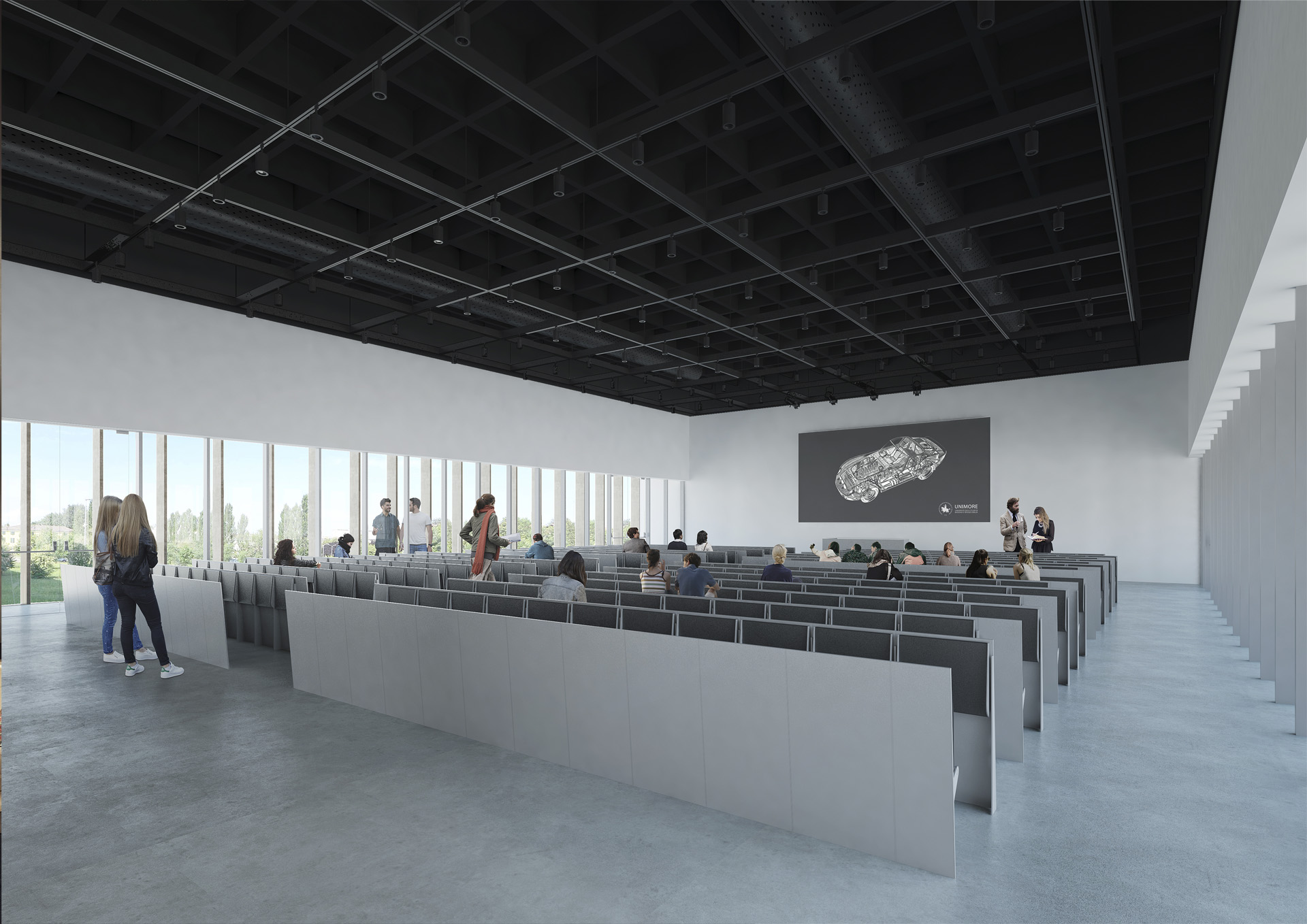

When we participated in the competition for the Enzo Ferrari Educational Pavilion at the Engineering Campus of the University of Modena and Reggio Emilia (UNIMORE), we envisioned a new concept of campus with a strong urban character — a place connected to the city, where thought and knowledge could circulate freely among members of a community of talents integrated within the neighborhood’s local context. By combining genius loci with community, humanism with innovation, we imagined this campus as a sort of hortus universalis: a garden open to the city, where ideas could find nourishment, circulate easily, and be shared.
The educational pavilion — containing five classrooms for 1,100 students — was conceived together with the university as a communal space, a place to live and learn. From the outset, the goal was to promote through architecture a renewed civic art capable of elevating the campus into a paradigm of excellence and coexistence, inspired by inclusion and cultural diversity.
Respecting the alignment with existing buildings, as prescribed by Antonio Andreucci’s master plan, the new pavilion projects towards the public street with a generous cantilever, creating a shaded gathering area beneath. This space fosters new social interactions between the university and the city, marking the new entrance to the campus.
At the heart of the pavilion lies a full-height central atrium, naturally lit by zenithal light. This atrium represents the ultimate common area — a welcoming, open place for meeting, studying, and socializing.
The pavilion is organized on three levels hosting classrooms and ancillary functions. All learning spaces benefit from indirect natural light and views of the surrounding park. At the top, a large common room provides an additional place for study and gathering, extending naturally outdoors onto a panoramic terrace — a belvedere open to everyone. The outer façade features a vertical brise-soleil system that filters direct sunlight while offering glimpses of the university’s vibrant collective life.
Through the seamless sequence of indoor and outdoor spaces — from the covered plaza and central atrium to the belvedere terrace and the intersecting staircases encouraging informal encounters among students — the vision of a true community-based university environment comes to life, one where the boundary between campus and city gradually dissolves.